
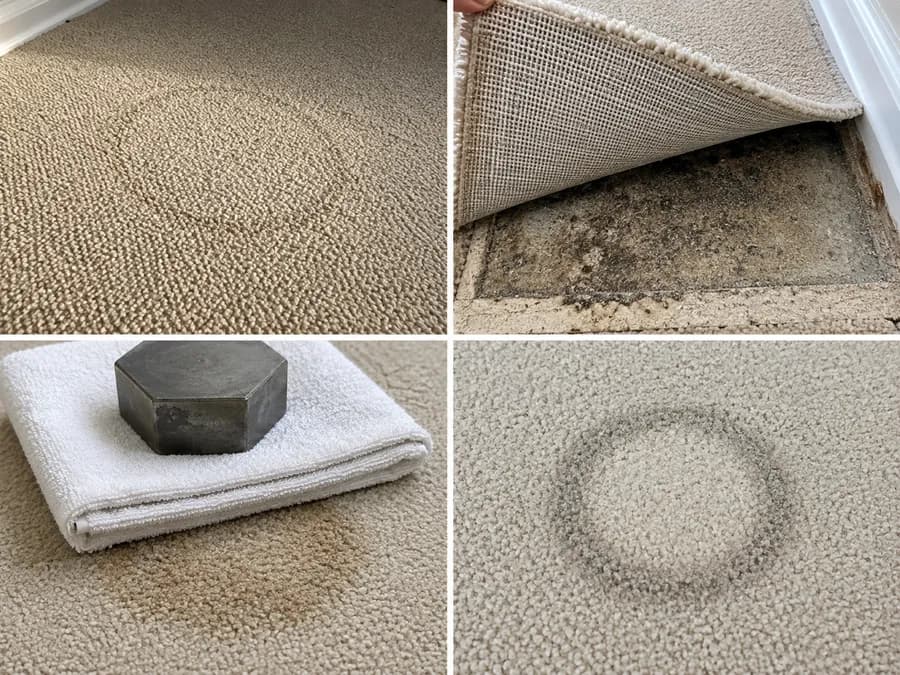
A stain that returns two or three days after a clean is almost always wicking. Soil left in the backing or pad travels upward with moisture as the carpet dries, then redeposits on the surface.
Three things cause a returning mark, and they need different fixes. Wicking comes from soil below the surface. A grey patch weeks later comes from detergent residue. A shadow that was never really gone comes from damage rather than dirt. Below: how to tell them apart in under a minute.
Quick answer: Stains reappear because soil deeper in the carpet wicks upward as moisture evaporates, usually one to three days after cleaning. Re-treating and extracting the spot removes it. Slow drying and leftover detergent make it worse. Tell us about a stain that came back.
What Is Wicking, and Why Does It Happen?
A spill rarely stops at the surface. Liquid sinks through the pile into the backing and sometimes the pad, spreading two to three times wider as it goes.
Cleaning removes what sits in the pile. Anything below that stays, and as the carpet dries, moisture travels up through the fibres and carries dissolved soil with it. The mark returns in the same shape, one to three days later.
Timing gives it away. Wicking shows up 12 hours to 3 days after the visit, never during it, and the returning mark is usually fainter than the original.
Two conditions make it far more likely: a spill that soaked deeply in the first place, and slow drying afterwards. That is why a wicked stain is most common in basements and in humid weather, when the carpet takes a day or more to dry.
Which of the Three Causes Do You Have?
| What you see | Cause | Fix |
|---|---|---|
| Same shape, faint, 1–3 days later | Wicking | Re-treat and extract the spot |
| Grey patch, spreading, weeks later | Detergent residue | Rinse the area properly |
| Mark never fully left, no change | Damage, not soil | Patch or spot dye |
| Yellow shadow near a pet area | Urine in the pad | Sub-surface treatment |
| Brown edges on a light carpet | Cellulosic browning | Acidic rinse, fast drying |
Cellulosic browning is the one people misread most often. On jute-backed or natural-fibre carpet, slow drying pulls tannins out of the backing itself, so the brown was never a spill at all.
Marks that never really left belong to a different category. Our guide to permanent carpet stains covers those seven cases.
How Do You Fix a Stain That Wicked Back?
The ten-minute home fix
The method below takes ten minutes and clears most cases.
- Dampen the spot with clean warm water. No detergent. You are re-dissolving soil, not adding chemistry.
- Blot hard with white towels. Press with your palm or stand on it. Work from the outside inward.
- Weight a dry folded towel on the spot overnight. As the area dries, remaining soil moves into the towel instead of the carpet.
- Repeat once if a faint mark stays. Two rounds clear most wicked stains.
Reading the towel
What the towel picks up tells you which of the three you have. Brown transfer means wicking, and it improves with each round. No transfer at all means damage, and a fifth attempt changes nothing.
Professional re-treatment uses the same principle with extraction instead of towels. A returning stain is a normal callback rather than a failure. Our guarantee covers it: anything that reappears after we leave, we come back and deal with.
Why Does Detergent Residue Turn Into a Grey Patch?
Detergent left in the pile stays sticky, and sticky fibre holds every particle of soil that lands on it. The area greys faster than the carpet around it, so within two or three weeks the cleanest spot becomes the dirtiest one.
Rented machines and consumer spot sprays fail this way most often. Both apply plenty of cleaning solution and recover very little of it, and neither includes a rinse step.
The Carpet and Rug Institute's technical guidance on preconditioning and rinsing treats the rinse as one of the required steps. Skip it and you get the grey patch.
Fixing it takes a plain-water rinse and thorough extraction across the whole affected area, not just the one visible patch.
How Do You Prevent Stains From Coming Back?
Dry fast. Moisture carries soil upward, so cutting drying from 12 hours to 5 leaves far less time for wicking. Fans and airflow do more here than any product.
Do not over-wet. More water pushes soil deeper and slows drying, which doubles the problem instead of solving it.
Rinse whatever you apply. Every spot treatment, home or professional, needs one pass of clean water after it.
Treat spills fully, not visibly. A spill blotted until it looks gone has usually left liquid in the backing. That reservoir is what a stain wicks back from six months later.
Drying speed is the one variable you control most easily. Times by method are in our carpet drying guide.
When Is a Returning Mark Not Wicking?
Pet urine behaves differently. Two symptoms give it away: a yellow shadow and a smell, both coming from the pad. Neither is reachable by surface work, as our guide to pet urine odour explains.
A musty smell returning alongside a mark points at moisture in the pad rather than soil. That is a third problem, covered in our guide to musty basement carpet.
A mark that reappears in a slightly different place each time is not a stain at all. Two shifting marks usually mean something is still leaking onto the carpet.
Frequently Asked Questions
How long after cleaning do wicked stains appear?
Usually 12 hours to 3 days, once the carpet has dried. A mark visible while the carpet is still damp is more often residue or an incompletely removed spot.
Is a stain coming back the cleaner's fault?
Not necessarily. Wicking comes from soil that was already below the surface, and it can happen after correct cleaning. It should still be fixed, which is why a callback is normal.
Can I fix a wicked stain myself?
Yes, in most cases. Dampen with clean water, blot hard with white towels, then weight a dry towel on the spot overnight. Repeat once if a faint mark remains.
Why is my carpet greyer after cleaning than before?
That is detergent residue attracting soil. It needs a plain-water rinse and extraction across the whole area, and it is the usual outcome of a rented machine with no rinse step.
Do brown edges mean the carpet is ruined?
No. Brown edges on a light carpet are usually cellulosic browning from the backing during slow drying, and an acidic rinse with fast drying clears it.
A Stain Came Back?
Send a photo and tell us when it reappeared. If we cleaned it, we come back and fix it. If someone else did, we'll tell you what it is and what it needs.
Get My Free Quote · Call (289) 933-9724